
If you’re a small business owner trying to decide between WordPress and Wix, the conversation usually starts with design and ends with “which one is easier?” But that’s the wrong place to focus.
The real differences are cost, ownership, flexibility, and whether your website is something you control or something you simply rent.
At first glance, Wix, Squarespace, and GoDaddy’s website builder seem like the simple route. You sign up, choose a template, drag a few sections into place, and you’re live. For someone just trying to “have a website,” that’s appealing.
But most businesses don’t just need a website. They need a marketing asset.
And that’s where the gap starts to show.
The Real Cost Difference
Website builders typically advertise low monthly pricing. But once you add what an actual business requires — custom domain, no ads, SEO tools, better storage, booking functionality, e-commerce capability, analytics, or email integrations — you’re often paying $30 to $50 per month.
That turns into $360 to $600+ per year. Sometimes more.
Over five years, that’s $2,500 to $3,000+ just to keep the site online.
And you don’t own the infrastructure.
You’re renting space inside their ecosystem. If you cancel, the site disappears. If pricing increases, you absorb it. If you want to migrate, it can be complicated.
Now compare that to a properly built WordPress website.
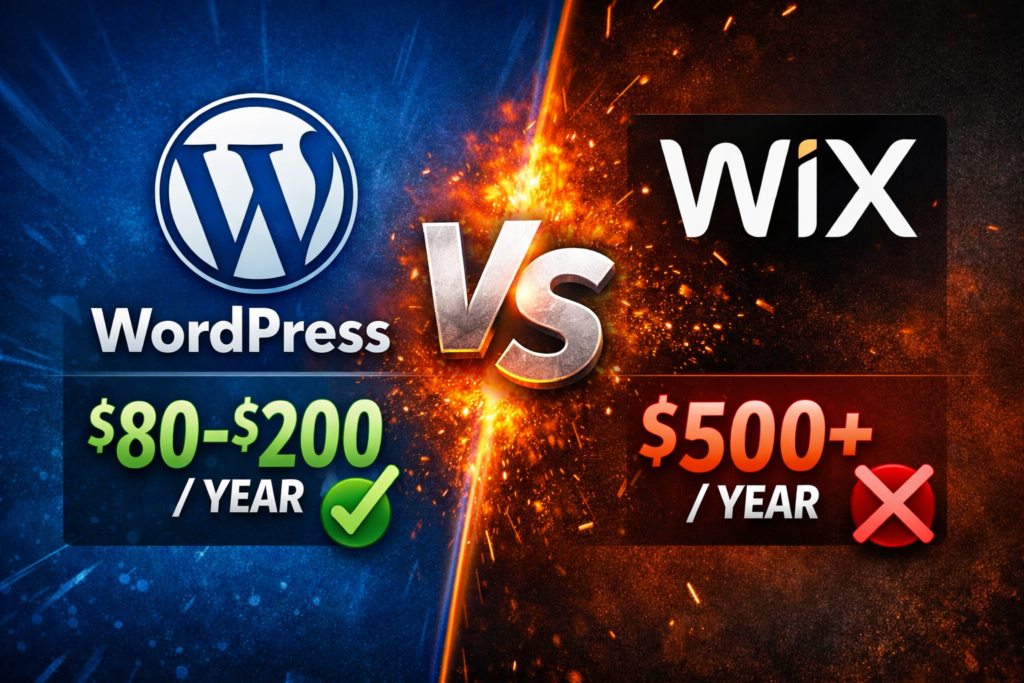
A quality hosting environment for a standard business site typically runs between $80–$200 per year. Add your domain (usually around $15 per year), and that’s your base cost.
No inflated subscription structure. No mandatory builder lock-in. No “business tier upgrade” just to remove platform branding.
Over time, that difference compounds significantly.
Ownership vs Rental
This is the part most business owners overlook.
With Wix or similar builders, you don’t truly own the system. You operate within it. That may not matter on day one. It matters on year three.
With WordPress, you own your site files. You control your hosting provider. If you don’t like your hosting company, you migrate. If you outgrow your setup, you scale. You’re not boxed into one vendor’s pricing model or limitations.
For businesses thinking long term — especially in competitive markets like DFW — ownership matters.
SEO and Growth Potential
Search engine optimization is where WordPress really separates itself.
Wix has improved its SEO tools over the years, but it still simplifies backend control in ways that limit advanced optimization. WordPress allows full access to:
- Custom URL structures
- Advanced metadata control
- Schema markup
- Page speed optimization
- Technical SEO configuration
- Clean internal linking strategies
If you’re trying to rank for competitive terms like “website design in DFW,” “marketing agency in DFW,” or “SEO services near me,” you need flexibility.
WordPress gives you that.
It also integrates more seamlessly with CRM systems, automation platforms, analytics tools, and advanced marketing funnels. As your marketing grows, your website should grow with it — not limit it.
Security and Stability
Another factor rarely discussed in builder comparisons is security.
With website builders, security is handled “for you,” but you have little visibility into how it’s structured. You trust the platform.
With WordPress, when built properly, you can implement layered security measures such as:
- Web application firewalls
- Malware scanning
- Login attempt restrictions
- Two-factor authentication
- Server-level hardening
- Performance and caching optimization
This doesn’t mean WordPress is inherently safer. It means it gives you control.
And control matters when your website is tied to your revenue.
Ease of Use: The Honest Trade-Off
Yes, Wix is easier out of the box.
If you want something simple and don’t plan to modify it much, it can work. For hobby sites, personal pages, or temporary projects, it may be sufficient.
But most growing businesses eventually need:
- Custom landing pages
- Lead generation funnels
- Paid advertising integrations
- Blog content clusters
- Local SEO targeting
- Industry-specific content
- CRM integrations
- Booking or quote systems
When that moment comes, many Wix users realize they’ve outgrown the platform.
That’s when migration becomes more expensive and more complicated than starting with the right foundation.
Long-Term Thinking
A website isn’t just a digital business card anymore. It’s the foundation of your marketing.
If you’re investing in SEO, paid ads, social media, or local search, your website needs to be structured properly from the beginning.
Spending $500+ per year on a website builder subscription may not feel expensive monthly. But when you compare that to $80–$200 per year for independent hosting — while maintaining ownership and flexibility — the math changes quickly.
It’s not about choosing the cheapest option.
It’s about choosing the option that gives you leverage.
When Wix Makes Sense
To be fair, Wix isn’t useless.
It makes sense for:
- Personal projects
- Very small service providers with no growth plans
- Temporary landing pages
- Test concepts
But if you plan to scale, compete in a strong market like Dallas–Fort Worth, invest in SEO, or build structured marketing campaigns, WordPress is the stronger long-term asset.
The Bigger Question
This isn’t really about WordPress vs Wix.
It’s about whether you want to rent your website or own it.
A properly structured WordPress website keeps annual hosting costs reasonable — often between $80–$200 per year — while giving you full control, better SEO flexibility, stronger security configuration, and long-term scalability.
If you’re exploring your options or considering rebuilding your current website, you can see how we approach website development and marketing structure here:
https://sanctus-marketing.com/services/
The question isn’t which platform is easiest today.
It’s which platform positions your business to grow — without overpaying year after year.