
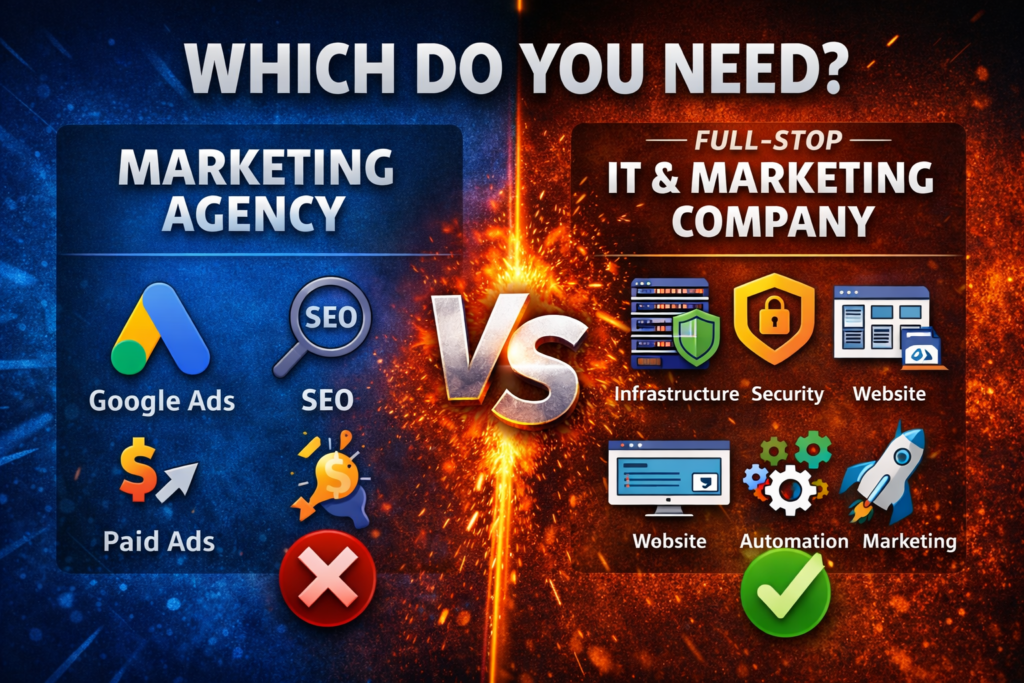
Most businesses don’t struggle because they lack marketing.
They struggle because their marketing is disconnected from their technical foundation.
Traffic alone does not build a stable company. Systems do. If your website is slow, insecure, poorly configured, or technically flawed, no amount of SEO, paid advertising, or social media posting will fix that long term.
That’s the difference between hiring a traditional marketing firm and working with a team that understands both infrastructure and growth strategy.
Here are seven powerful reasons why that distinction matters — especially in competitive markets like DFW and beyond.
1. Marketing Without Technical Support Is Incomplete
Most marketing agencies focus on visibility:
- Search engine optimization
- Paid ads
- Social media campaigns
- Content creation
Those services matter. But they’re only part of the equation.
What’s often missing is:
- Hosting performance
- Server configuration
- Security hardening
- Backup systems
- Email authentication
- CRM integration
- Automation workflows
When something technical breaks, you’re told to “contact your developer” or “reach out to hosting.”
Now you’re coordinating between vendors instead of running your business.
An integrated structure removes that friction.
2. Growth Magnifies Your Weak Points
Marketing doesn’t repair weak systems. It exposes them.
If your website takes four or five seconds to load because of underpowered hosting, advertising campaigns simply send more visitors into a poor experience.
If your forms aren’t secured properly, you’ll increase spam volume instead of qualified leads.
If your email authentication isn’t configured correctly, marketing emails may land in junk folders.
Increased traffic amplifies whatever already exists — good or bad.
When the foundation is strong, marketing accelerates growth. When it’s weak, it accelerates frustration.
3. Security Directly Affects Performance and Rankings
Search engines evaluate more than keywords. They assess:
- Page speed
- Stability
- User experience
- Security
If a site is compromised, frequently offline, or redirecting visitors due to malware, visibility suffers.
Traditional marketing firms rarely manage:
- Firewall configuration
- Vulnerability patching
- Malware monitoring
- Login protection
- Server-level optimization
Yet these factors influence trust, rankings, and conversions.
When technical stability and marketing strategy operate together, performance improves naturally because both sides are aligned.
4. One Team Means Clear Accountability
Many business owners experience this scenario:
The marketing agency blames hosting.
Hosting blames a plugin.
The developer blames the ad scripts.
Meanwhile, leads are slowing down.
When strategy and infrastructure are handled by the same team, there is no finger-pointing. Issues are resolved instead of redirected.
That clarity alone reduces stress and saves time.
5. Your Website Is Built to Evolve
Most companies outgrow their initial website setup within a few years.
They need:
- Location-specific SEO pages
- Structured landing page systems
- CRM automation
- Advanced analytics tracking
- Booking integrations
- API connections
- Content clusters for authority
A marketing-only firm may hit technical limits.
An IT-only provider may not understand conversion structure.
When both perspectives are present from the start, expansion doesn’t require a rebuild. The site evolves without starting over.
That scalability protects your investment.
6. Long-Term Cost Efficiency
Hiring separate vendors may appear affordable initially.
But fragmented systems often lead to:
- Emergency security repairs
- Downtime losses
- Rebuilds due to poor architecture
- Migration expenses
- Wasted ad spend from performance issues
Fixing problems repeatedly costs more than designing properly from the beginning.
When infrastructure and promotion are aligned, you reduce duplicated work and avoid constant patchwork fixes.
Doing it correctly once is almost always cheaper over time.
7. Strategy and Execution Stay Connected
This is where alignment becomes powerful.
Through
👉 https://www.sanctus-solutions.com/services
we focus on secure, optimized infrastructure — performance, protection, and stability.
That foundation supports the structured marketing systems built through
👉 https://sanctus-marketing.com/services/
to drive visibility, authority, and lead generation.
This approach keeps:
- Hosting
- Security
- Technical SEO
- Analytics tracking
- CRM systems
- Campaign execution
working together instead of operating in silos.
Instead of running ads and hoping your website can handle traffic, we ensure the platform is technically prepared first.
Instead of publishing content without structure, we build internal linking and optimization strategies that support long-term rankings.
Instead of designing something that only looks good, we design something that performs under real traffic conditions.
Why This Matters in Competitive Markets
In competitive regions like DFW, digital presence is not optional.
Businesses that treat their website as a true operational asset outperform those who treat it as a simple marketing brochure.
Performance optimization, backend structure, security configuration, automation, and conversion tracking are not extras. They are part of modern growth.
When these components are separated, inefficiencies appear.
When they are unified, growth becomes more predictable.
The Bottom Line
Marketing firms focus on visibility.
IT providers focus on systems.
Bringing both together creates stability and momentum.
That means:
- Clear accountability
- Stronger infrastructure
- Better-performing campaigns
- Reduced security risk
- Lower long-term costs
- Sustainable scalability
If you’re investing in growth, the foundation matters just as much as the traffic.
Build the system first. Then scale it.